The Bridge Between Knowing and Doing
We are living in a moment of unprecedented access to health information.
Every day there are podcasts, books, research summaries, Instagram posts, reels, newsletters, documentaries, and conversations about what we should be eating, how we should be moving, how to sleep better, manage stress, and age well.
And of course there are people like me — sharing ideas, research, and experiences in the hope that something might help someone feel better — physically, mentally, and emotionally.
But the reality is that this landscape now includes a huge range of voices.
Doctors.
Nutritionists.
Exercise physiologists.
Fitness trainers.
Health coaches.
Biohackers.
Wellness influencers.
And everyday people who have discovered something that worked for them and feel passionate about sharing it.
Many of these voices are thoughtful and well-intentioned. Some are deeply trained in the science. Others are speaking primarily from personal experience.
Which leads to a very real question:
With all of this information coming at us — how do we know what to trust, what actually matters, and what is worth acting on?
One framework I often return to is the illness–wellness continuum.
Not because it tells us exactly what to do.
But because it reminds us what we’re aiming for.
Movement toward greater resilience.
Greater capacity.
A body that is supported, not depleted.
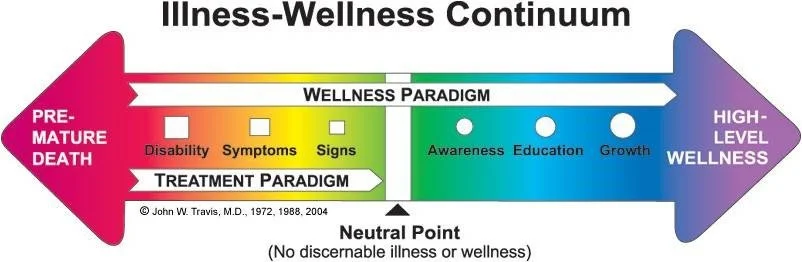
On the right side of that continuum sits awareness and education — understanding the daily choices that support the body’s systems and help us move in that direction.
But awareness alone doesn’t move us forward.
It changes how we see.
Because when we begin to understand what our habits are actually doing inside the body, something shifts.
Meals are no longer just meals … they are nourishment for billions of cells.
Movement is no longer just exercise … it becomes a signal that helps preserve muscle, protect metabolic health, and support long-term independence.
Sleep … becomes the time when the brain clears waste and the body repairs itself.
In other words, education matters.
When we understand how our choices support the body — feeding the gut, protecting the liver, stabilizing blood sugar, supporting the brain — those choices begin to feel more meaningful.
But here’s the part that often gets overlooked.
Awareness doesn’t tell us exactly what to do next.
And in a world full of conflicting advice, that can feel overwhelming.
So instead of trying to find the perfect answer,
it can be more useful to take a different approach:
To experiment.
To notice.
To pay attention to how your body responds.
Not everything needs to be believed.
Some things simply need to be tried.
Because the truth is — most supportive habits are not extreme.
They are simple. Repeatable. And often surprisingly familiar.
The work is not finding something radically new.
It’s choosing what feels aligned, trying it, and seeing if it moves you forward.
And if it doesn't?
You adjust.
You return.
You try again.
And of course, often we're sitting in the middle of a very full life, with seemingly very little available time. And in that environment, even good information can quietly sit on the sidelines.
Not because we don’t care.
Not because we don’t understand what matters.
But because real life is complex, and translating information into consistent action requires something more.
It requires structure.
This is why I care so much about the quiet structure of everyday habits.
Not dramatic overhauls.
Not perfect eating.
But small systems that lower friction and make the supportive choice easier:
Meals that create steadiness.
Kitchens that make nourishment convenient.
Movement that reminds the body to stay strong.
Routines that reduce decision fatigue.
Because information can point us in the right direction.
But it is structure that allows that direction to become a life.
Our habits shape who we are.
Our attention shapes who we become.
This is also exactly where coaching can play a powerful role.
Not by adding more information to an already crowded space.
But by helping clarify what actually matters, translating that knowledge into practical steps, and helping remove the obstacles that get in the way of consistency.
In other words — helping build the bridge between knowing and doing.
If you’re feeling stuck — or just want help turning this into something actionable for you — we can talk it through together.
Just select “Contact” on the top menu bar.